Tuesday, December 11, 2012

Austrian M.75 combat helmet (part one)


.


Hey, Austria isn't Germany, although Austria was the blushing bride of Germany in the Second World War and participated in many of the evil hi-jinx of the Third Reich.  Today however Austria is a member in good standing of both the UN and the EU.  Officially neutral, Austria does have a well-trained standing army, following Switzerland's example of needing a strong army to preserve the idea of neutrality in a complex world.  Ain't it the truth.

Three Austrians of note:


Christopher Plummer as Captain Von Trapp. Nice Jacket


Fictional American Harry Lime who hung out in Vienna
who was a fictional dick.   Nice smile.


Arnold Schwarzenegger former body builder, governor, actor and the accent that everybody thinks they can do really well "Ahhhh-nold."

Hollywood must really like Austria


I really like the Austrian M.75 steel combat helmet


Another US M1 clone, this helmet has been around since the seventies and is even featured on a cool Austian postage stamp:


Is it just me or is there a resemblance between these two Austrian G.I.s and Bill Mauldin's "Willie and Joe" cartoon G.I.s?


Austrian soldiers in ranks with helmets or turbans (non-ballistic I'd imagine).


Let's take a walk around this nice lid.


The exterior porvides no surprises for the fan of...


the venerable,  and apparently, venerated US M1 helmet.


Save for the chinstrap...


and the non-textured finish, this is a dead-ringer for the American "steel pot"


The netting is uniquely Austrian, with a much larger weave than that of the M1 of WWII.


From above there are no surprises, but the big differences are apparent...


when you get a gander at the suspension and chinstrap.


The chinstrap has two garter fasteners including the anti-concussion one in use here. The open end allows the strap to give way should a concussive shock-wave, generated by a nearby explosion, pull at the helmet of the wearer; or so I am given to understand.


Taking a cue from its German neighbors (in a good way, this time),  the brow of the leather suspension has numerous rows of ventilation holes.


Nylon bushings provide impact space between the suspension and the shell.


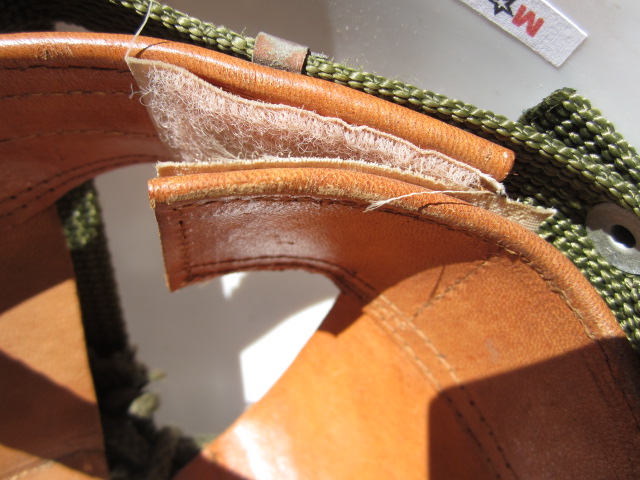
The nine-fingered suspension is stamped with the size as  well as the wearer's name and branch of service, "Bundesheer" is the army in Austria, as opposed to "Bundeswehr" is the army in Germany.

I used to see lots of young people here in the US sporting Bundeswehr athletic shirts prompting me to coin this marketing slogan:

"Bundeswehr is Fun to wehr"

Such a wag am I.


other, less distinct, markings are underneath.


This sliding buckle provides for some adjustment for the wearer.


The fingers are nicely grommeted and a very sturdy cord draws them all together at the center.


The liner itself if very similar, though certainly not identical to the M1.  It seems, in this view at least, to be slightly drawn-in along the rim.  It also has a riot of rivets.


Oddly, only about half of these rivets are even connected to the suspension, leading me to believe that there may be an airborne configuration of this liner which would utilize those otherwise idle rivets.


The helmet shell has one marking indicating, I imagine, the maker and date of manufacture.


Again, as with the M1, the separate rim is butt-joined and spot-welded.


The chinstrap bales are quite identical to the M1 swivel bales.


Behelmeted soldiers of the "Eastern Kingdom" blaze away at those who dare to challenge their neutrality.


Another very handsome helmet from Europe that owes its good looks to its progenitor the good old, reliable, and much-copied American M1.

"Stick with a winner" I always say.

See you next time with another cool helmet from the collection.

Mannie


.

Sunday, November 11, 2012

Remembering the Great War

(photo by David DeJonge)

I had the pleasure of being interviewed by my old friend David DeJonge about helmets and how we remember the men of the Great War.

Please check out David's efforts to restore the First World War Memorial in Washington DC here.

Wednesday, October 24, 2012

Spanish Military Police (M1 clone) Steel Helmet

.

Yankee go home! (but leave your helmet)


The classic US M1 helmet has been copied by numerous nations, some best buddies like Taiwan (go here), also some dear acquaintances like the Netherlands and Denmark (likewise, go here and here).
 Our Cold War allies (save for the British Commonwealth countries), even France (for awhile) adopted the M1 or started producing their own domestic clones of that classic design.  It was an anti-commie love-fest, everybody in matching helmets.

Spain is an interesting exception to that rule.

Spain and the United States have not been such good pals, some have gone as far as to opine that Spain is the most anti-American country in the galaxy (here).


[fun times in Barcelona]


Goodness, such fussing between two such nice peoples; and when one considers the histories of the two countries one will find some disquieting similarities.

Despite the ill-feelings, Spain after its long love affair with the German-style helmet (here) adopted (in 1983) the venerable, and very much American, M1-style helmet.

At last, something we can agree upon.


Two members of the policia militar, one martial, the other groovy.


Although very similar to the US M1 this home-grown Spanish clone is entirely of Spanish manufacture and the differences in the two helmets become immediately apparent when looking at that distinctive chin cup and cotton-webbing liner strap.


The "draw marks" visible in this view indicate a thickness not nearly as great as the M1


Another difference is the raw edge of the Spanish model. The M1 has a separate rim providing a very "finished" look and feel.


The "loop within a loop" chinstrap fasteners are quite handy and the bale is nearly identical to that in the M1


The distinctive chin-cup provides for great stability however the plastic material is 
not particularly rugged.


The liner has rivet placement unlike the M1 as well as...


a pair of ventilator grommets.


These ventilators lead me to believe that the liner is more likely to be stand-alone headgear than would the complete liner and helmet combination, witness the above picture of the two youthful PMs.


Here's the meat-and-potatoes of the liner suspension and where any similarities to the US M1 take their leave.  The five-leaf suspension is distinctly European as is the leather construction.


The liner strap bales are unique as well.  Note the crack above the bail.  The plastic liner, as with the chin cup, is not particularly durable.


Velcro, that great legacy of the space-age, provides size adjustment for a snug fit.


The liner is nicely marked with this manufactures embossment in the dome.


Although of very simple design and inexpensive material this liner clip does bear some resemblance to the similar fitting in the M1


A phalanx of PMs armed and ready for action.


Spanish soldier...
American soldier.

Why can't two such cute countries just get along?


A fine looking M1 clone in Spanish livery
ole!


.

Sunday, October 21, 2012

1970 US Army MacGregor Tanker's Helmet


-

Conservation

Readers of this blog frequently email with questions about the cleaning and restoration of helmets.  I don't really think that anything can be restored, entropy being what it is, however nearly anything can be conserved.

"Restoration" makes me think of Norma Desmond:


Yikes!

"Conservation",  on the other hand, allows one to grow old gracefully; a conserved helmet will always be able to say "I'm ready for my close-up Mr. Demille."


This post shares some things I learned from twenty years in museum work.


(Me with Custer's shoulder strap 
and Lee's sash, both in the 
holdings of the Public Museum
 of Grand Rapids Michigan)

The old curator sez:

Conservation means stopping the agents of deterioration from further degrading the object, and, protecting the object from future degradation.

Active rust, grime, and mold are three things that can degrade or damage a helmet.  Those conditions need to be halted to prevent further deterioration of that helmet.

The greatest tools in conservation are:
1. a rough towel
2. a little warm water
3. an eraser
4. a soft toothbrush
5. a dehumidifier

and...

6. a very light touch.

I qualify this whole discussion with the knowledge that one can do anything that one wishes with an object that one owns - cover it with sequins if that's what tickles the fancy; hey, its your helmet, not mine.    But if one wishes to take a more measured approach here are some things to consider.

Rust:
Set aside a cast-off towel to be used for cleaning your helmets.  A rough toweling will remove 60% of the crud that's eating your helmet.  The soft tooth brush will remove most rust scale, and for removing very surface rust a pencil eraser can be very effective.

Grime:
Warm water, with a drop or two of dish detergent used in combination with that towel (moist only) will work wonders in removing grime, here's where patience and a light persistent touch will remove detrimental material but not compromise the object or its finish.

Mold:
Mildew and active mold blooms are very frustrating as once they establish a beach head in leather it is usually there for the duration.  The impulse is usually to hit it hard with bleach or some equally noxious fluid to kill the mold and the spores, but all that will do is damage the leather and lead to its quick demise.  Leather "treatments" merely lock in the spores which can remain dormant for many years only to erupt later.  The best thing with mold is to towel or brush the visible mold from the surface and plug in the dehumidifier - forever.  Once the environment dries out the mold will stop growing; if the environment getshumid again the mold will reappear, much to the regret of the collector.  My dehumidifier runs every day and my helmets are much healthier for it.


Meet Meis van der Rohe

He would have made a great helmet conservator with his "less is more" philosophy; maybe that's why "conservative" and "conservation" have the same root.  The idea is simply to retard or stop the further degradation of the object.


This brings us to the last step, especially in the prevention of further rust.  Micro crystalline wax is a staple among museum conservators, it provides a protective (and reversible) coating on metal to keep it from rusting further.  The pits caused by rust cannot be filled in, but the offending oxidation can be removed and the wax can be applied to prevent rust from becoming active again.


Gaylord Inc. carries a full range of museum and library conservation supplies and they are an industry standard in the museum world.


Conservation; an example:

In Gettysburg PA I picked up a MacGregor football-style tanker's helmet which was in need of some TLC.  At 34 bucks the price was right even though the lid was looking a little shabby.  An hour of work with the materials listed above proved that there was a pretty nice helmet lurking just below all of the surface crud.

I love "before" and "after" shots, so kindly indulge me.

This is one of the rusty and crusty liner fasteners on the helmet as purchased


A pencil eraser was brought to bear to remove the worst of it:


 Here's the inner padding half-way through cleaning with a damp towel:


that same towel was brought to bear on the upper lining which was very grimy


Moments later, this appeared:


The earphone bushing had some light oxidation and rust. Some serious wielding of an eraser produced nice results.


Much better.


Here's the lid before cleaning and application of the micro crystalline wax:


And here is the "after" shot


The whole process took no more than a very pleasant hour sitting in my shop listening to the radio and drinking a soda.  What I'm left with is a pretty respectable addition to the collection...

A MacGregor Armored Vehicle Crewman helmet from 1970.

The US Army fiddled around with civilian football helmets since the Second World War and this version of an olive drab "Mister Touchdown" lid appeared, if only briefly,
 during the Vietnam War.


Wilson, Riddell, and MacGregor helmets saw service as paratrooper and tanker helmets in an interim capacity. This lid was the lightweight stop-gap on the long road to the US CVC helmet which I blogged about in 2008 (go here).


This is a just standard football helmet fitted with earphones  and a  boom microphone and chinstrap.
("sis-boom-bah" mic?)


On this specimen only the mounting holes and studs remain,


though the earphones are still intact and in place.


Markings consist only of this interior label and...


this very civilian label on what is, after all, just a football helmet in G.I. livery.

At 34 dollars and a little elbow grease, its a very nice addition to the collection.


Conserved and among friends.


-