Monday, March 27, 2017

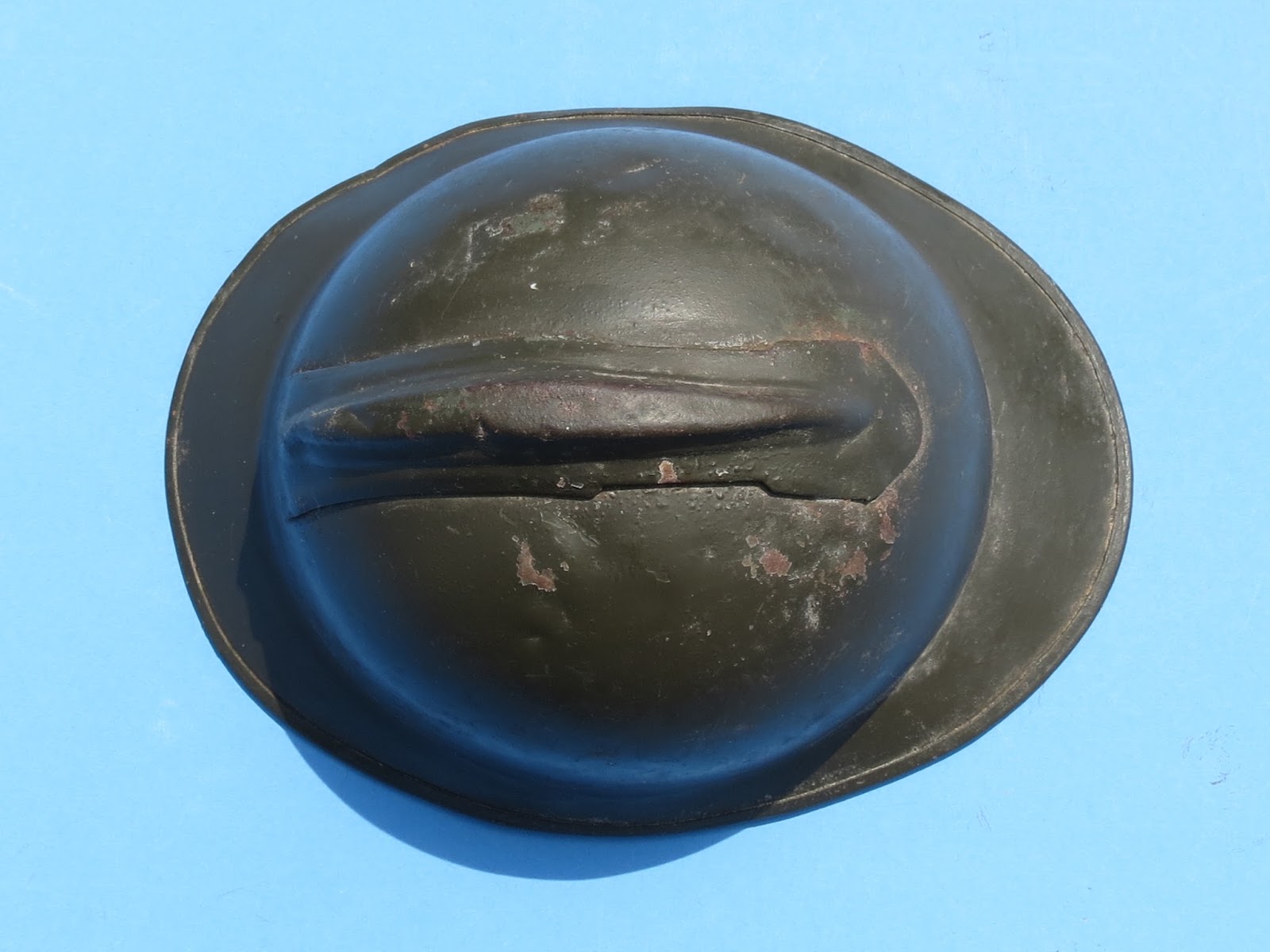
United States U.S. Navy "talker" helmet.

"Maintain proper circuit discipline"
I occasionally heard that phrase come over my headphones as a young Radioman in the early '70s as I was wearing the
Mk II "talker" helmet.


The Mk II was designed in 1942 and was in use well in to the 1980's.  It was a very large and somewhat ungainly helmet to wear though it did serve its purpose very well.  It was designed to accommodate the wearing of headphones for Radiomen or anyone
using shipboard sound-powered phones.


The Mk II was manufactured by the McCords Radiator Company in Detroit Michigan; 
 the "Arsenal of Democracy".


Its composition is non-magnetic Hadefield manganese steel.


In addition to accommodating headphones it also provided
a great deal of protection to the wearer.


The bowl is so wide it even provided some coverage to the shoulders of the sailor who was underneath it.


Okay, it does look a little like the helmet Rick Moranis wore in the movie "Spaceballs".


Painted sea blue the Mk II, like the Mk I, has cork applied with the paint to provide a textured, non-reflective surface.


The leather chin bales are affixed with brass wire as brass doesn't corrode in the salt water environment of shipboard living.


The liner is composed of a vinyl rubber material by Firestone
 and B.F. Goodrich.
(see ad at bottom of page)


One can easily see in this shot the channels that provide clearance for headphones as well as the head of the wearer.  The padding is very thick and semi-flexible.


The chinstrap is of horse leather and the slider-buckles are made of non-corrosive aluminum.


The chincup has a chamois leather layer next to the skin of the wearer.


I seldom found one of these helmets in which the liner didn't smell of mildew from the marine environment and it was common to have it separated somewhat from the shell.


The rim is a separate piece of magnetic steel...


and the inside of the shell is marked in ink.


This particular helmet was acquired by me for twenty dollars from noted collector and helmet authority Floyd Tubbs in the early 1980's at a militaria show in Lansing Michigan.  I found Mr. Tubbs to be very gracious and always very willing to share his expertise with a new collector.


See you next time with another cool helmet from the collection.

Mannie

Thailand m.30/32 combat helmet

 A recycling story...


If you were a nation occuppied by the Japanese in WWII you find yourself awash in Japanese military materiel upon their surrender.  Suddenly your army (such as it is) has lots of helmets.


Such was the case with Thailand.  A small army, a whole bunch of Japanese helmets, just add insignia, and away you go.


The distinctive Japanese 30-32 profile in Siamese livery.


Ventilation holes in the dome.


This example has mounts for the French m. 26 liner and chinstrap.


Close-up of riveted mounting frame for the liner...


though the mounting holes for the original Japanese liner are apparent.


Back story...

Remember back in the late '70s and early 80's seeing ads in military magazines for genuine Japanese helmets for only 15 (later 25) bucks? Sounded like a rip-off, but what the heck, it was only fifteen dollars, so I gave it a shot. The helmet I got in the mail proved the adage: "You get what you pay for"; a stripped-down Japanese helmet sans liner and insignia of any sort.


On the plus side it did have a chinstrap, though it was unlike any I was used to seeing on Japanese helmets, and had the French-style suspension for a liner intact. What was most intriguing about this helmet though, was the printing on the remnants of newspaper that were stuck to it (obviously this helmet had been in storage for some time). The script on the newspaper fragments was unlike any I'd seen before. It was definitely not Japanese, nor was it Chinese or Korean. That puzzled me. Also, on the front of the shell, where an insignia had been, was the distinct and symmetrical outline of that missing insignia. The outline was clear and very distinctive, and again unlike the shape or size of any Japanese insignia that I was familiar with.


Mystery aside, I felt a little sheepish about this helmet and pretty much tucked it away in the old "live and learn" box, where it stayed for almost 25 years until it suddenly became somewhat of a prize.


In the intervening 25 years a couple of things happened: the publication of that outstanding book by Paolo Marzetti "elmetti di combattimento di tutto il mondo" (Combat Helmets of the World) and the advent of ebay.

Marzetti's book gave me my first glimpse of the Siamese model 1930-32 which was simply a salvaged Japanese 30-32 with a replaced liner (French m.26 style) and leather chinstrap.

  And mounted on the front, with that distinctive outline that had so puzzled me was the embossed metal Siamese insignia. Shortly after that, as ebay came into full-flower, I successfully searched out and obtained that helmet plate. The helmet came out of storage, the insignia was affixed, and suddenly that cast-off was placed front and center in my collection with some of the other more obscure models.

A very nice ending indeed.


See you next time with another cool helmet from the collection.


Mannie

Sunday, March 26, 2017

Italy m. 1915/16 combat helmet (part two)


A Roman soldier walks into a bar, holds up two fingers and says: "Five beers please".

That's my Italian joke.


And here we have jolly Italians during the Great War wearing the m.15/16 steel helmet.


Obviously influenced by the French Adrian helmet, this attractive Italian manufactured gem, also known as the Lippmann helmet, simplified the construction process and eliminated many of the weaknesses of it's French progenitor. The Italian soldier of 1915 - 1916 had the next step in state-of-the-art helmet design.


This elegant improvement of the French Adrian design included a two-piece construction rather than the four-pieces of its French counterpart. Fewer pieces meant fewer points of failure when impacted by debris, fragments, or shrapnel.


The steel of the m.15/16 was slightly thicker than it's French cousin, providing 
slightly better ballistic characteristics.


I've often read that the crest on the Adrian-style helmet was to deflect saber blows.  I don't believe this for a moment.  The helmet design was based upon the French fireman's helmet. A fireman has many things to worry about, but a crazed bystander wielding a sword is seldom one of them.


This model did come in three sizes, the largest of which weighed 1.6 pounds.


Another improvement to the integrity of this helmet was the elimination of rivets. The French Adrian helmet was riveted together, each rivet providing a weak point. Note that the ventilator crest of this little Italian job is spot-welded, all rivets are eliminated on this helmet, giving it improved structural integrity over its French cousin.


As with the French model, slits in the base of the crest communicate an opening in the crown of the shell...


which allows for ventilation.


The rim has a folded edge.


There is no liner, though two of the corrugated spacers remain.  These shallow pieces of rippled metal are the only spacing between the shell and the skull of the wearer.  Compared to the German m.16 and the American m1917, this method looks primitive.

And now some photos of the m.15/16 in action.


I see a lot of knives in this picture...


it seems to be a theme.


See you next time with another cool helmet from the collection.

Ciao!

Mannie

Saturday, March 25, 2017

Portugal m. 1916 combat helmet


Now, as is usual with these posts, some photos and graphics of the m.1916 in action:


Pictured at center, in this group of Portuguese and British prisoners
is a soldier sporting the m.1916.


Now, I have to get back to that barbecue!


See you next time with another cool helmet from the collection.

Mannie