
For starters, we'll begin with this resource: https://www.digitalcommonwealth.org/search?page=20&q=PASGT+helmet+development&search_field=all_fields
It is the photo archive for the U.S. Army Natick Soldier Systems Center (NSSC), and is packed with great photos regarding the development of the Kevlar - PASGT helmet.

The facility is in Natick Massachusetts.
Since 1947 the Natick labs have been responsible for the research, design, and development of helmets, body armor, clothing, and many, many other things that involve the personal protection of the soldier, including the PASGT helmet.

Natick nerds obtain critical measurements for the design of the new helmet.
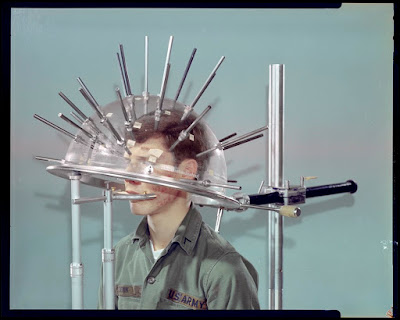
Here is a blurb from the Defense Department regarding the history of the Natick labs:
Construction of the Quartermaster Research Facility (QRF) at Natick, authorized by Congress in October 1949, began in November 1952. A year later, the QRF was redesignated as the Quartermaster Research and Development Center, and four years later as the Quartermaster Research and Engineering Command. July 1961 saw the activation of the U.S. Army Research Institute of Environmental Medicine at Natick and a year later the QREC was placed under the U.S. Army Materiel Command (AMC). In November 1962, the QREC was redesignated as Natick Laboratories and the following year the Food and Container Institute moved to Natick. In July 1967 the Navy Clothing and Textile Research Facility relocated to Natick.
In the early 1970s NATICK embarked on a new helmet project that was part of an overall protection system known as PASGT - Personal Armor System for Ground
Troops - generally referred to as the "Paz-get".
It was a start from scratch effort which kept very little of the old M1 design, and forged ahead into the future with the world's first composite combat helmet, in this instance, made of Kevlar.

Side-by-side of the new and the old. The earliest PASGT models were painted with a modified ERDL camouflage pattern.

Natick scientist with wicked comb-over posing with calipers and prototype helmet.

The PASGT helmet is usually referred to as the "kevlar helmet", also the "k-pot" and the "Fritz" helmet for it's resemblance to the German helmet of the First and Second World Wars.

The various elements of the airborne-version of the PASGT helmet.
.
The protective properties of the helmet were extensively tested and refined, along with the protective body armor which is part of the PASGT system.

All of that R&D resulted in a brand-new helmet, and the modern symbol of the American service member for the next twenty years. Introduced in the mid1980s, the PASGT helmet proved a superior and worthy successor to the venerable M1 helmet at the end of its fifty-year run. The M1 helmet saw our military through three wars and numerous smaller conflicts; it was an excellent helmet that had simply become obsolete as new weapons and new materials became available.
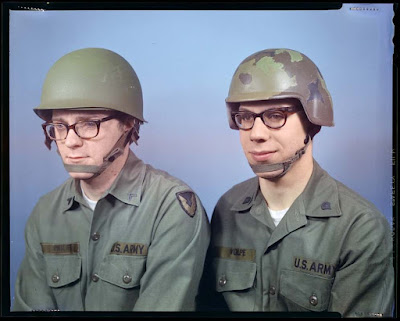
As the Poindexter brothers demonstrate, the new PASGT provided more protection for the brain than did the old M1.

This graphic provides a picture of how much of the brain was protected by the PASGT helmet.

Prior to coming to my collection, this helmet had been on display at Natick labs for many years and eventually ended up, forgotten, in a closet. I received the helmet from the employee who was assigned with cleaning out that closet...funny the way s things show up on my helmet wall.


The bulged sides were specifically designed to accommodate the slim-profile of current radio handsets...


.png)
The profile shows the similarity to the German Stahlhelm design.


The only M1 influence that remains is the Riddell suspension; even the headband is different.

The rim is bound with a heavy plastic strip. The anti-reflective surface treatment is shown to good effect in this photograph.

All of the webbing and hardware is particularly robust, and the chinstrap is fastened with a heavy-duty snap.
.heic)
The chinstrap incorporates a simple, but effective, chin-cup which is quite comfortable.

Mounting furniture utilizes through-holes in the shell, each could be a weak-point in this otherwise well-designed shell.

In the days of the M1, and even the earlier versions of the PASGT, the headband was secured with metal spring clips, velcro bands are utilized in the PASGT

The DLA number indicates that the helmet was manufactured under the1987 contract, and the embossment in the dome indicates that this particular helmet was manufactured in 1998 or '89.. Unicor was one of a few companies which produced the PASGT helmet.

The camouflage cover was made in or after 1998.

The button hole-like slits allow for foliage to be attached to the cover.

The airborne-modification kit includes a yoke strap and a rubber shock-absorbing pad at the nape. Additionally, there is a rubber disc in the dome, which is missing on this example.

The yoke passes through two slits at the rear of the helmet, and is fastened by velcro.

Similarly, the chinstrap passes through slits on the lower edge of the cover.
.png)

I can only imagine some Natick wag tricking this out as DC Comics Sargent Rock's helmet.


I have interviewed soldiers who wore both the M1 and the PASGT, in all instances they preferred the PASGT for protection, comfort, and even looks. A friend in the 82nd Airborne noted that he and his colleagues thought that the helmet "looked cool."

A small length of paracord feeds through the foliage slits on the cover to secure the elastic camouflage band in place.


Glow-in-the dark "cat's eyes" help the goodguys identify each other in the dark.


The "woodland" pattern of camouflage was adopted in 1981, replacing the Mitchell pattern of the Vietnam era.

.png)
For the purposes of my collection, the PASGT is my final US helmet in the 20th Century chronology. In the early 2000s the PASGT was phased out in favor of a visorless version which provided as much protection with more capability, specifically for firing a weapon from a prone position.
I think that the PASGT helmet was a worthy successor to the iconic M1.
See you next time with another cool helmet from the collection.
Mannie
Military One Source, Military Installations, https://installations.militaryonesource.mil/in-depth-overview/natick-
Yonggiang, Li, Science Direct vol 238, June 1, 2022, Ballistic helmets: Recent advances in materials, protection mechanisms, performance, and head injury mitigation. https://www.sciencedirect.com/science/article/abs/pii/S1359836822002694#preview-section-references
U.S. Army, USAG Natick, https://home.army.mil/natick/my-fort/newcomers
Digital Commonwealth, Massachusetts Collections Online, PASGT helmet development, https://www.digitalcommonwealth.org/search?page=8&q=PASGT+helmet+development&search_field=all_fields
Reynosa, Mark A., (PASGT) Helmet: an Illustrated Study of the U.S. Military's Current Issue Helmet. Schiffer Military History, 1999.
Army Navy Warehouse, Using Contract Numbers to Determine Dates on Military Gear, July 7, 2020. https://www.armynavywarehouse.com/post/contract-number-dating
Camopedia, United States, https://www.camopedia.org/index.php/USA


