Tuesday, February 4, 2020

South Korea m. 76 combat helmet


South Korea is a country on the brink.  


To the north lies its traditional and seemingly eternal enemy - The People's Democratic Socialist Republic of Spiders and Flies -  ruled by a hare-trigger nutcase with a whacked-out haircut named Kim Jong Un.  Un, like his father before him, has found a way for his people to live on a diet of nothing more than twigs and meth-amphetamines, thus allowing him to pump all of the nation's meager resources into offensive weaponry.


Whether feeding relatives to dogs or firing ballistic missiles in all directions like your uncle Elmer on the Fourth of July with a fist of bottle rockets in one hand and a cold Budweiser in the other.  Kim is nuts and unpredictable.


Neighbored by a heavily-armed man with bugs in his brain, South Koreans are keenly aware of the precarious armistice that has been holding since the end of the Korean war in July of 1953.  South Korea's capital city, Seoul, is only 31 miles from the border with N. Korea - within easy range of Kim's long-range artillery...of which he has an abundance.


South Korea has relied, in varying degrees, on the assistance of the United States to maintain the balance of power and keep the armistice intact.  Indeed, since the nearly the birth of the new nation the South Korean forces have been almost entirely equipped with American materiel including the standard US M1 helmet.


The M1 was the front-line helmet for S. Korean forces until 1976 when the new composite helmet was introduced.  Although different in most ways from the venerable M1,  the m. 76 still retains the distinctive profile of it's American progenitor.


Here's the walk-around:


Only the external rivets and the squared-edge of the brim distinguish the outward appearance of this helmet from the American M1.

The chinstrap is a near-twin to the final generation American M1 version.


Made of a synthetic material  called corlon,  this helmet has ballistic capabilities that are superior to the Hadfield manganese steel of the American M1.

The m. 76 entered service in 1976 and is still the front-line helmet of S. Korean military forces.


The distinctive pyramid-pattern of rivets at the brim secure the chinstrap-bail bracket.
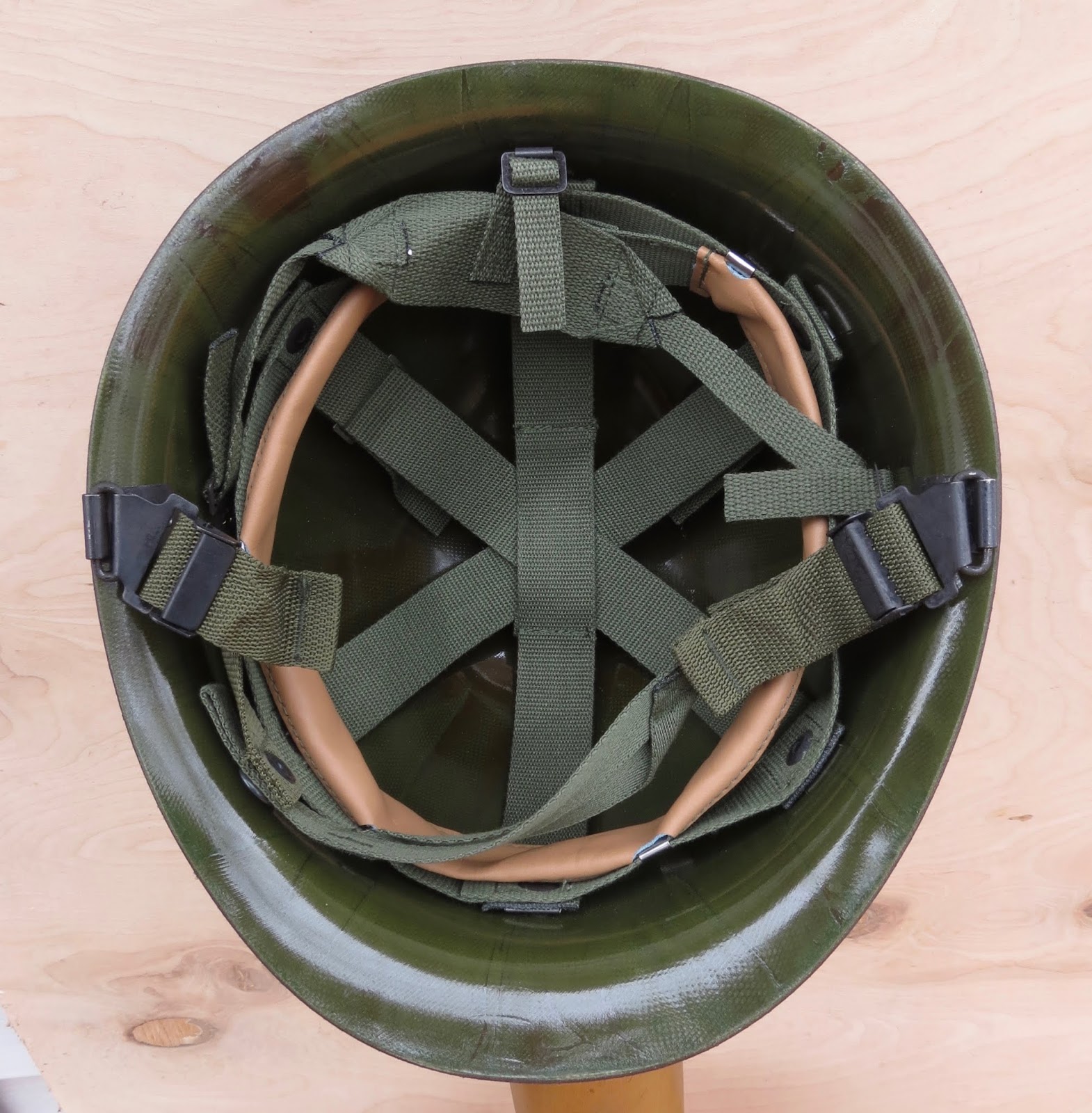
This helmet does not have a separate liner as did the US M1.  Although the suspension is a near dead-ringer for the M1, it is connected directly to the shell.


The top view demonstrates the least imaginative photo I have ever shot.


Chinstrap brackets are riveted to the shell.

The sweatband, like the M1, is leather, and the clips that secure it are the same spring-loaded type as found on the M1

The m.76 also has the same nape-strap as the final generation M1.

Also identical to the M1 is the chinstrap.

The manner in which the strap is fastened to the bail makes it easy to replace.

It fastens with a robust snap.

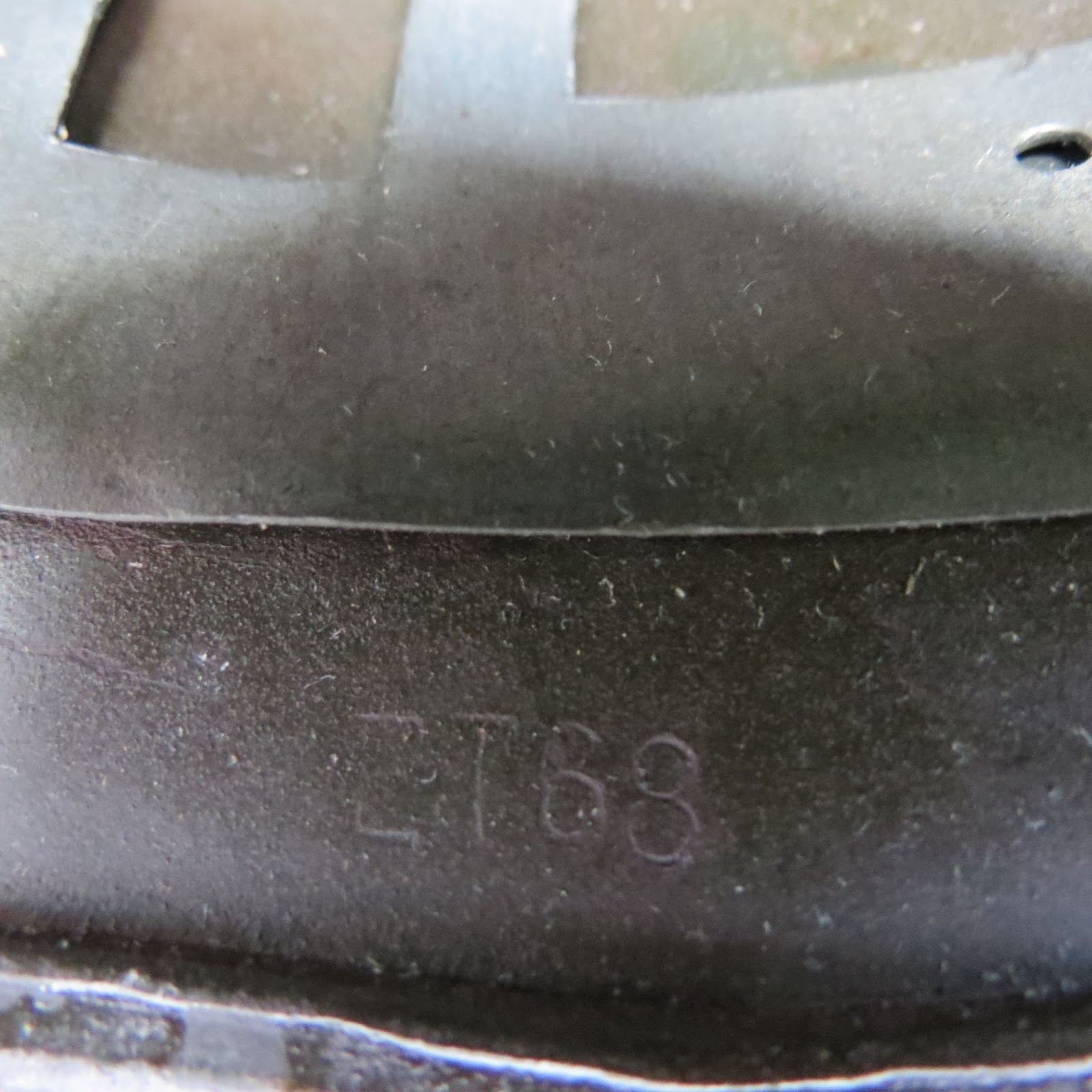
The only markings reside in the dome of the shell.


South Korea also manufactures the m.76 for export, including to Iraq.

The Iraqi m. 80 is on the left.

The suspension is very similar to the m.76 although the material is comparatively flimsy.  Note the attachment of the simple chinstrap.  The manner in which it is affixed makes it impossible to replace.

The suspension is leather and the cotton material is of a very loose weave.


Now for some photos of the m.76 in action:


One last look.  This helmet came with a pretty cool digital camouflage cover.


I'll see you next time with another cool helmet from the collection.


Mannie

Monday, June 19, 2017

Nazi Germany m.38 Fallschirmjäger combat helmet


The Fight of the Century!


(A premium seating ticket to the first Louis Schmelling fight)


American heavyweight boxer Joe Louis met with his German counterpart Max Schmeling twice.  In the first fight Schmeling won by a knockout in twelve rounds.  Adolf Hitler used it as an opportunity to trumpet Aryan superiority and German mastery in the ring as well as on the world stage.

The second matchup came on June 22, 1938; the results couldn't have been more different, Louis won by a knockout in 2 minutes and 4 seconds, Schmeling was only able to land two punches.  Louis was the heavyweight champion of the world, and the master race had been delivered a KO.


Louis towers over his vanquished opponent.

Hitler made great overtures to Schmeling, all of which the fighter rebuffed.  "I am no superman in any way" Schmeling said.  Further, much to Hitler's displeasure, when Schmeling was fighting in the U.S. he refused to fire his Jewish promoter, Joe Jacobs. 

With the outbreak of the Second World War, and Schmeling back home in Germany, he was drafted into the Luftwaffe and was accepted into the elite Fallschirmjager forces.


Schmeling on the cover of the German propaganda magazine Signal, wearing his m.38 fj helmet.  Schmeling was in no way sympathetic to the Nazi cause, and post-war anecdotes have him sheltering two Jewish children at the beginning of the war.


Wounded in the assault on Crete Schmeling was medically discharged and spent the remainder of the war participating in morale-raising exhibition bouts.
---
Joe Louis however, was a willing volunteer, joining the US Army early in the war.  In a highly publicized meeting with the president of the United States, Franklin D. Roosevelt is credited with saying to the "Brown Bomber"; "Joe, we need muscles like yours to defeat Germany."

Louis spent the entirety of the war assigned to US Army Special Services where he participated in exhibition fights to raise morale and boost sales of War Bonds.


In a period of racial discrimination and so-called white supremacy, Louis was able to win over many whites with his whole-hearted support of the war effort and his much-reprinted and much quoted statement; "...we'll win because we're on God's side."
---
Frequently over the years, I have been the grateful recipient of helmets given to me as gifts. You can only imagine my delight, this Spring as a acquaintance gifted me with what is now a show-piece of my collection - the much coveted German m.38 paratrooper (fj) helmet.

Although the helmet lacks chinstrap and liner, the shell is in very good condition with the paint about 80% present and the decal wonderfully intact.

Just for the sake of display I added a reproduction chinstrap, and rather than compromise the helmet's originality by undoing the bolts to mount the straps, I merely tucked the ends of the straps under the liner band.  The result is, to me, visually pleasing.


The shell shape is essentially that of an m.35 with the brim and skirt removed.

The liner is secured to the shell by four robust screw and nut combinations.  These slotted screws represent the third and final production design of the m.38.

All that remains of the liner is the aluminum liner band, affixed  by the the screw and nuts...
which also secure the chinstraps, of which, here, only the ends remain.

The size, as in the m.35 family of helmets, is stamped
 inside the shell.
Another number, the significance of which is unknown to me, is stamped just above the rolled edge at the inside front of the shell.
Holes on the liner band allowed the leather liner to be attached.
The liner band is joined by solder at the front.
\
Most of the green paint remains intact.


The slightly misapplied decal gives this helmet some character.

And now, the usual gallery of the helmet in action:


Often FJ helmets were fitted with a fabric camouflage cover.


An FJ trooper decked out in a polka dot ascot and smoking a cigarette;
as if combat wasn't deadly enough.


And what of Joe and Max?


Here they are in 1971. 

These two champions developed a close friendship that lasted until Louis' death in 1981.   Schmeling was one of his old friend's pall-bearers.

 In 2005 at the ripe old age of ninety-nine, Max Schmeling went to his celestial reward, leaving behind the memory of his role in what became known as "The Fight of the Century"...perhaps a metaphor for that even greater fight of the century...

the Second World War.


See you next time with another cool helmet from the collection.

Mannie