Thursday, June 2, 2022

Fifty years of collecting, and trying to stay honest


 Here's something that I've been thinking about lately.

In this hobby of ours, too often opinion, folklore, and conjecture masquerade as fact. 

Last night I went through my collection of helmet books.  I was disappointed, though not surprised, that only one of them cited primary sources and gave attributions.  That book was Tin Lids, by Roger Lucy.

Many of those who trumpet their expertise on the subject, don't adhere to the basics of research methodology, that is, they cite no sources for their assertions.  Anecdotal accounts from "vets" are a poor substitute for primary sources...memories change, facts and details become fuzzy, conjecture trumps actual memory.  This is not to say that first-hand memories are valueless - they are good supplemental material, but they are no substitute for documentation

I'm looking at my collection of helmet books very differently now, and some, because of the author's lack of scholarship, or damaged reputation, have been rendered little more than pretty pictures bound in glossy covers.  Pretty pictures of helmets which may or may not be legitimate.

Many of the biggest names in the hobby (though all too often they have reduced the hobby to little more than an investment opportunity) eschew primary sources, and instead, anoint themselves arbiters of what is known, or what can be known, about the subject of helmets...and presto!  their conjecture becomes gospel, endlessly quoted, re-quoted, and self-quoted, in a circular manner.  Also noteworthy is that some leading authorities in the hobby have lost their reputations due to their willing participation in the promotion and sales of counterfeit and faked helmets.

As a beginning collector, it is very important not to be dazzled by an expert's resume.  Without citing primary sources they are merely peddling their opinions.  Personally, I find conjecture an incredibly tedious waste of my time.  When you seek out information, embrace your skepticism, and avoid getting "star-struck" by the heavy-hitters in the hobby.

Of course that applies  as well to the information that you glean from this blog.  Seldom do I cite sources, but equally seldom do I dabble in conjecture.  I tell you what I know or what is self-evident, I qualify any opinions as just that,  do a walk-around of photos, and provide "action shots" for context.

I also invite "comments and corrections."

In this blog, and in all of my helmet videos, I state up front that I am not an "expert" but only an experienced beginner. As of this year, I have been actively collecting helmets for fifty years, starting with a Japanese type 90 that I found when I was stationed on Guam in 1972 (here).  Despite this longevity in the hobby, I am still learning and trying to learn.

Without scholarship, this hobby becomes merely folkloric; and for me, that makes the hobby less fun...and if a hobby isn't fun, then what's the point of it all?

Keep collecting, keep investigating, and keep having fun.

See you next time with another cool helmet from the collection.

Mannie

Sunday, January 9, 2022

South African mk.II production video

This video was brought to my attention, and I'd like to share it with you.  I always like footage showing how things are made, in this instance, South African mk.II combat helmets,  I hope that you enjoy it.


Happy new year,

Mannie

Sunday, December 5, 2021

Happy Holidays from Combat Helmets of the 20th Century.

 Happy holidays everyone, and thanks for following my blog.  


See you next year, with more cool helmets from the collection.

Mannie

Singapore m.C1 combat helmet

Gum chewing will not be tolerated in Singapore.


For this post, I asked friends if they have ever been to Singapore, and to very briefly describe it.  Here is a sampling:

    •  Regimented grid masquerading as a cosmopolitan island country
      1
      • Like
      • Reply
      • 16h
  • Yes, it’s a beautiful city/state with repressive laws
    1
    • Like
    • Reply
    • 16h
  • ‘73 aboard Higbee. Stunningly beautiful and unlike any other city we visited that cruise. A jewel.
    1


    • Like
    • Reply
    • 16h
  • Been there many times. Probably as close as you can get to visiting a British colony these days. Very strict. Nice people. Good food. The cabbies spy on you. Great aquarium. Where are the British surrendered without a fight.
    1
    • Like
    • Reply
    • 7h
    • Edited
  • Yes, in 1997. Hot and expensive


My minimal research tells me that Singapore is very wealthy, very safe, very beautiful, and more than a little authoritarian with a certain distrust of democracy.  It is also illegal to chew gum, parade nude in your own home, and gatherings of more than three people are prohibited.  Seems like they would have more pressing things to worry about.

Singapore has a well-funded military, spending one of every four dollars on their armed forces, but with Red China at the front door, ample military spending may be pointless considering that the active-duty membership of the Singapore Armed Forces (SAF) is around seventy five thousand troops and China is 2.19 million.  Though to be accurate Singapore has mandatory conscription with reserve obligation to age 42.  This means that Singapore would be able to field a little more than a million troops...provided that they have enough time to do it.

Nonetheless, small and well-funded, the SAF has some great gear, including this kevlar helmet from the 1990s.


The m.C1 is manufactured in South Korea for export to Singapore.  Too tiny to have an industrial base, but wealthy enough to order out,  Singapore gets most of its military materiel from abroad...and only the best.


By way of comparison, here's the SAF helmet on the left and the first-generation US kevlar PASGT helmet on the right.


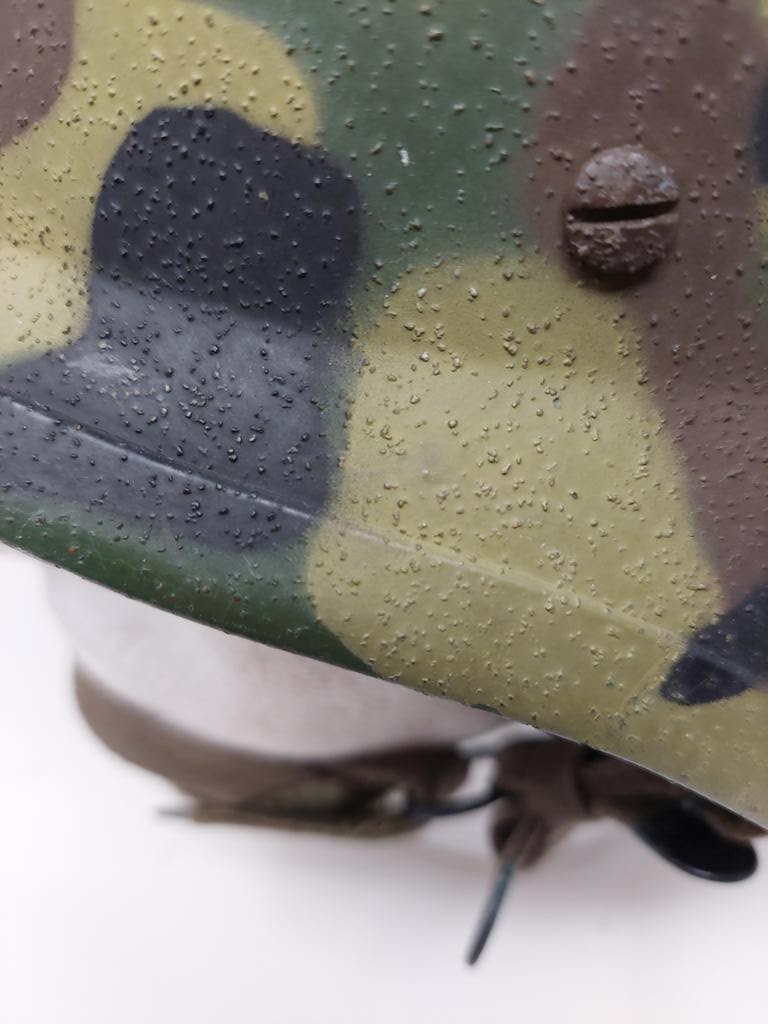
The shells and the screw placement are identical, the only visible differences are the finish...


and the manner of fastening the chinstrap bails - screws on the American, and rivets on the SAF.


Compared to a US airborne kevlar, one sees that the m.C1 also has the foam jump-pad in the rear.  This, and the three-point chinstrap makes me think that the SAFis airborne as well.


The helmet was adopted by the SAF in 1989.


 The US introduced the Kevlar helmet in 1982, so, though not an early adopter, Singapore did get with the ballistic-fiber program in a timely fashion.


The factory-finish woodland pattern adds to the effectiveness of the helmet for the soldier, as well as the attractiveness of this helmet to my collection.


As with the PASGT, the suspension is affixed with screws.


As mentioned, rivets affix the three-point chinstrap.


Like most airborne helmets since the 1940s, a rudimentary chin-cup is integrated into the strap.


The chinstrap furniture is blackened brass.  The strap is fully adjustable.


The release is velcro and very easy to use in a one-handed manner.


The suspension is the familiar and reliable Riddell-style that has been with us since the Second World War.


The m.C1 was delivered in both woodland pattern camouflage and flat olive.


Silver Star of South Korea is the exclusive manufacturer of the helmets supplied to the SAF.


The clips that attach the headband to the suspension are also no strangers to those familiar with the American version.


Given the tiny size of the SAF, I guess it shouldn't be unexpected that I was able to find so few photographs of this helmet in field use.


Although the Singapore Armed Forces may be no match for the People's Liberation Army...


just let the invaders try and get away with chewing gum.


See you next time with another cool helmet from the collection.

Mannie