Friday, March 3, 2023

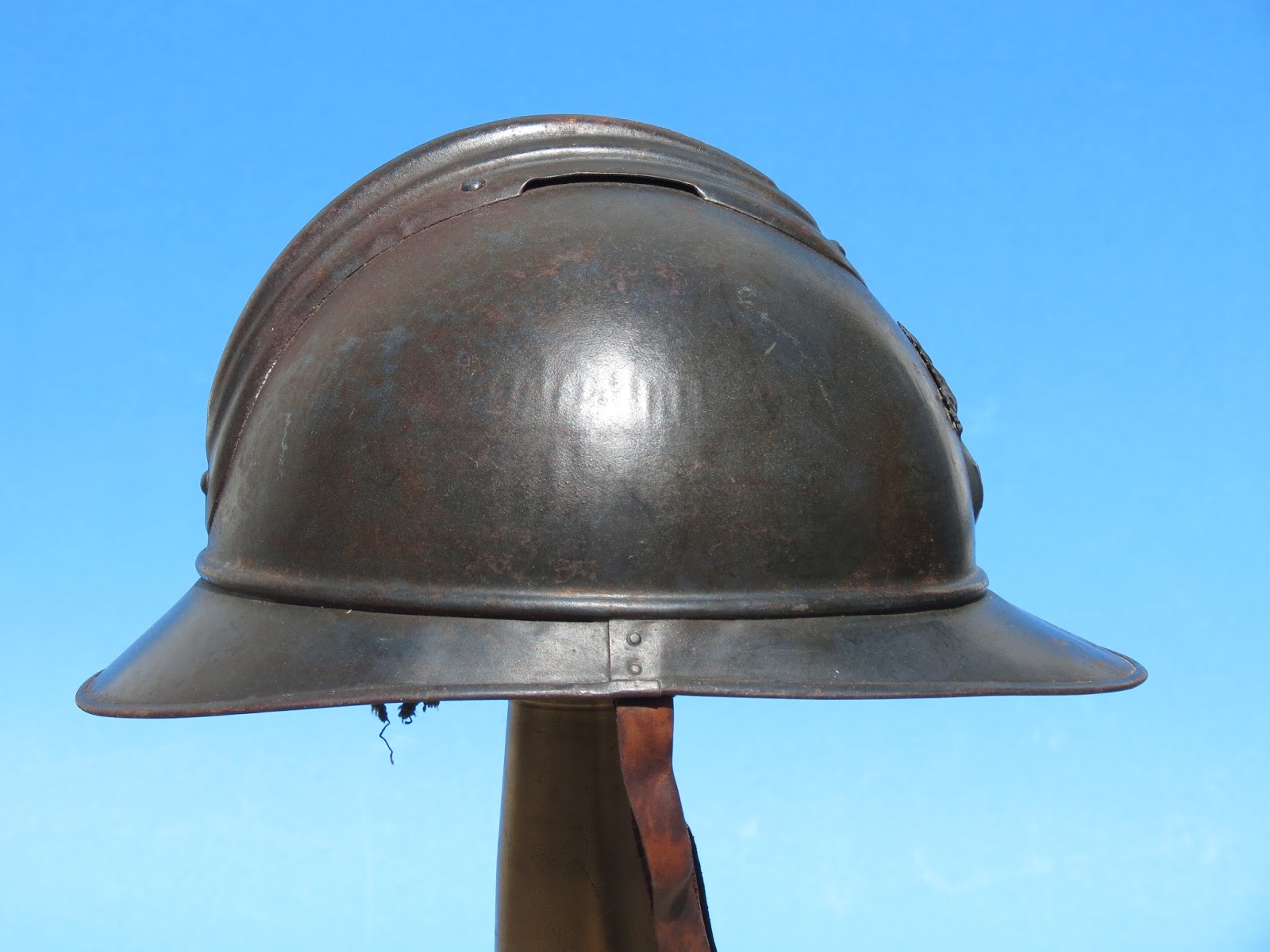
France m.1915 combat helmet (infantry)


General Adrian's wonderful helmet.


Excerpt from: Helmets and Body Armor in Modern Warfare by Bashford Dean, Yale University Press, 1920:

The French appear to be the first to accept the helmet in actual service and thousands of soldiers today bear witness to the practical value of the casque which was provided for them, notably through the efforts of General Adrian.

A few words as to the work of General Adrian... General Adrian sought ways and means in all directions for reducing his losses. One day he stood before a stretcher and talked with a wounded man --- "I had luck," said the sufferer, "I happened to have a metal mess-bowl in my hat and it saved my life."  This incident impressed the General deeply.  Here was the question of a device which might prove of universal value.  So with his usual earnestness, he attacked the problem of a head defense.  He promptly had a steel "calotte" made and fitted inside his cap; then he wore it constantly to find whether it would cause notable discomfort.  Next he had many of them made and used experimentally.

Good reports soon came in from the front. Thereupon, he developed the regular helmet which was manufactured in great numbers for the French Army.  At first this defense was turned out hastily, stamped from dies which had already served in making the helmets of firemen.

Investigation showed that the new helmet was of actual value in the field; hence it became a part of the regular equipment and was used by every soldier on active duty...

It is interesting to note that almost from the beginning the "casque Adrian" was a successful experiment.  It protected a measurable portion of its wearer; it was light and soldiers of all classes shortly "took to it."  The casque was attractive in its lines and it added martial distinction to its wearer - which proved, in the opinion of many officers, a more important argument for its use than its ballistic value.


French General August Louis Adrian made the battlefield a safer place for the soldier when he designed the first modern combat helmet (click the link for the video).

The French armed forces appeared on the field in the opening year of the Great War uniformed much as they had been fifty years earlier. Pomp and prettiness by the yard, but very little functionality either in personal protection or concealment.


Side view, showing both the distinctive profile of this beautiful helmet and , at the same time, exposing its inherent weaknesses. The helmet consists of four separate parts: front visor, rear visor, bowl, and crest. Each seam and each rivet represents a weak point, a place of potential failure. This helmet is very light, the steel very thin, the liner rudimentary, and the whole thing is made of only mild steel, still...

it was a breakthrough, and immediately fatalities from head wounds decreased.

The only way for protective equipment to be successful is if it is actually used. The French high command was pleasantly surprised with the enthusiasm that the French G.I.s accepted this helmet. It provided them with a martial élan, that stoked their professionalism and pride. In short, the French soldiers embraced it.

And the other nations took note.


The "flaming bomb" is the symbol of the infantry...


  this is much like the insignia of the US Army Ordnance Corps.


A critical weak point on this helmet, where the bowl and the front and rear visors
are joined together by rivets.


This close-up of the leather, wool, and metal liner demonstrate another weakness of this pioneer attempt a cranial protection: corrugated aluminum spacers provide less than a quarter of an inch separating the shell of the helmet from the skull of the wearer. Typical displacement of a dent in the helmet is an inch...so where does that leave the skull of the wearer? Improvements will come, but, still, this is much better than a cloth cap, ne conviendriez-vous pas ?


Manufacture of the helmet was a combination of machine and hand-work, and saw the employment of many female war-workers.


Multiple stampings form the bowl-shaped shell.

 Visible are the crimped edges which will accept the front and rear visors.

 Here, the crests have yet to be added showing to good effect the ventilation hole
at the crown of the shell
Assembling the liners.  These are the earlier one-piece versions.  Later in the war, in a move to conserve leather the ends of the leather fingers were separate pieces, allowing the manufacture to utilize leftover portions of leather.

Ready for shipment, and...

et voilà!


Now, for some action shots.


It seems as though General Adrian's helmet brought out the romantic in your average poilu.


La Mitrailleuse, 1915 by Christopher Richard Wynne Nevinson


Here we have a silent reminder of the dreadful cost of the Great War to the French:
1,357,800 dead, 4,266,000 wounded.


Before you go, check out the delightful label of this California winery, with the model 1915 as its logo.  How cool is that?


Link to Le Casque here, and raise a glass of this fine California wine in a toast to General August Louis Adrian, the man who started it all. Cheers!

See you next time with another cool helmet from the collection.

Mannie


Fifty years of helmet collecting

 Fifty years on has me a little reflective regarding my hobby.  I've posted about a Japanese type 90 that I found (or helped find) on Guam in 1972.  And that's where the bug bit me.


I've been collecting ever since then.

I've had as many helmets pass through my collection as I have in it now.  Over the years I've more and more, tightened the focus of the collection to include only ground and naval combat helmets, of the 20th century.

Gone are the aviaition helmets, military police, para-military, armored vehicle, civil defense, parade helmets, gone are the experimentals, gone are the stray M1 liners.  The collection now is about as curated as it is going to get and I get a great deal of pleasure out of it.

The collection is mostly garden-variety plain Janes, though there are three or four real stand-outs.  I'm very happy with it.

Where I'm going with this is, when I came home from the Navy in 1974 I would go to militaria shows and gun shows, looking for helmets.  And truly, I thought that I was one of the only people who had such a hobby,  Slowly, I became aware that I was part of a very large community of collectors who had the same interest as I.  There weren't the wealth of books and guides that there are today, but people like the legenday Floyd Tubbs gave me some good initial advice and encouragement.

I have seen  tremendous growth in the hobby over five decades.  And with the internet, facebook, and other online groups, one can see that the hobby is growing and attracting younger and younger collectors all the time.

I remember the evening at a friend's house, when he introduced me to ebay, maybe 25 years ago...at that time ebay had been around for a couple of years.  I immediately entered "helmet", and was presented with 1,200 auctions.  Tonight, there are over 25,000 active helmet auctions.

With this growth have come some downsides, including skyrocketing prices, and the plague of fakery.  Fakery to the degree that it often seems pointless to shop for WWII German helmets, or unit marked M1 helmets.  I caution beginner collectors to do as much research as they can before considering the high-end items; there are a lot of sharks in the water.

Despite that, I'm happy to see the hobby growing, and one of my greatest satisfactions with this blog, and my helmet videos, is to share my insights and advice with the beginners...and be clear, I never refer to myself as an expert. I am far from that; rather, I call myself an "experienced beginner."

Why don't you share (in the comments) your favorite helmet-collecting story.

Let's continue collecting and continue keeping the hobby fun.

See you next time with another cool helmet from the collection,

Mannie


Saturday, December 31, 2022

The ideas of preservation, conservation, and restoration; a video


A short video about how I have taken my work home with me...so to speak,


Friday, September 9, 2022

Nazi Germany, M.40 tropenhelm (with postscript)

In the mid 1980s a dear friend's husband passed away, and she gave me a big box of the things that he  brought home from the war. The items were all German and included, a police shako (urban), map case, complete mess kit, swastika flags, banners and armbands, tinnies, etc.  When I protested that she could get considerable money for this box of treasure, she responded that if I didn't take it it was going out in the trash. 

Norma's husband was Clarence "Chappie" Chapman.  Chapman went overseas in November '44 with the 75th Infantry Division. He spent one month in Wales and then went to LeHavre France in December of '44.  His first action was on Christmas eve in Ardennes Forest.  He saw a considerable amount of action.

After VE day Chapman served in Reimes and was involved in occupation efforts, organizing units to go to Japan, and sending others home.  Along the way he had accumulated a large amount of souvenirs, including this nearly pristine m.40 tropenhelm.


Lightweight, effective, and handsome, the m. 40 tropical helmet was a popular item of headgear among the Nazi German forces fighting in tropical and arid climates, especially in North Africa.

Comprised of cotton duck covered cork this lightweight helmet provided cool protection against an unforgiving sun.


This helmet is particularly comfortable to wear and seems feather-light compared to a steel helmet.


The rear brim is longer that the front and provides good solar protection for the back of the neck.


It's a well-designed and well-constructed helmet with a great deal of attention to detail.

The lightweight but sturdy, green-dyed leather chinstrap is adjustable with a sliding square buckle.  I have seen many photos of this helmet in action, but never with the chinstrap deployed.

The chinstrap is easily removed by a hook attached to the liner band.

The tricolor shield is on the right side of the bowl...

and the  army insignia  is on the left.

Both shields are affixed to the bowl with brass wires that pierce the cork and cotton and are clinched tightly.

The headband is made of high grade leather.

The size and manufacturer are ink-stamped inside the band.


To provide air circulation (similar to the pickelhaube) there is a clever ventilator on the dome of the helmet.

It screws into the perforated receiver that communicates air to the inside.


The band is neatly stitched at the rear, and another indicator of size is apparent.

Felt provides padding behind the band.

The headband and felt are attached to a metal band that is affixed with loops and cotter pins.


The rim of the helmet is edged with high quality leather identical to that of the chinstrap.

And finally, here are some photos of the m.40 in action.

Here is the high-quality m.40 (right) contrasted with the cheaper, pressed felt m.42 (left).

Note the counterintuitive Magen David on this Kraut's Christmas tree.

Two nice manufacturing process photos.  Above, adhesive and duck being applied to the cork shell...

and the shields being applied to the finished product.

Check out the despondent member of the master race at the lower right.  It all looked so much more glorious on the recruiting poster, didn't it pal?


A heretofore unpublished photograph of Erwin Rommel - the "desert fox."


Clarence M. "Chappie" Chapman
US Army
1943-45
75th Infantry Division, service company, 290th Infantry
France, Belgium, Holland, Germany. A participant in the "Battle of the Bulge" and a recipient of the Bronze Star and the Purple Heart.


Postscript, September 2022:  not quite a year and a half ago, "Chappie's" wife Norma passed away.  She was a great friend and always enjoyed talking about her much-loved husband.


Norma was a tireless volunteer in our community, and was known as much for her keen sense of humor as she was for her compassion .  I met Norma back in the early eighties when we were both volunteers at our Public Museum.  We gave many tours together, and though I was considerably her junior, we became good friends. Norma had wonderful stories of a West Michigan when horse-drawn vehicles were still common on the Streets of her hometown, Sparta.

Truly, an exemplary member of "The Greatest Generation."

See you next time with another cool helmet from the collection.

Mannie