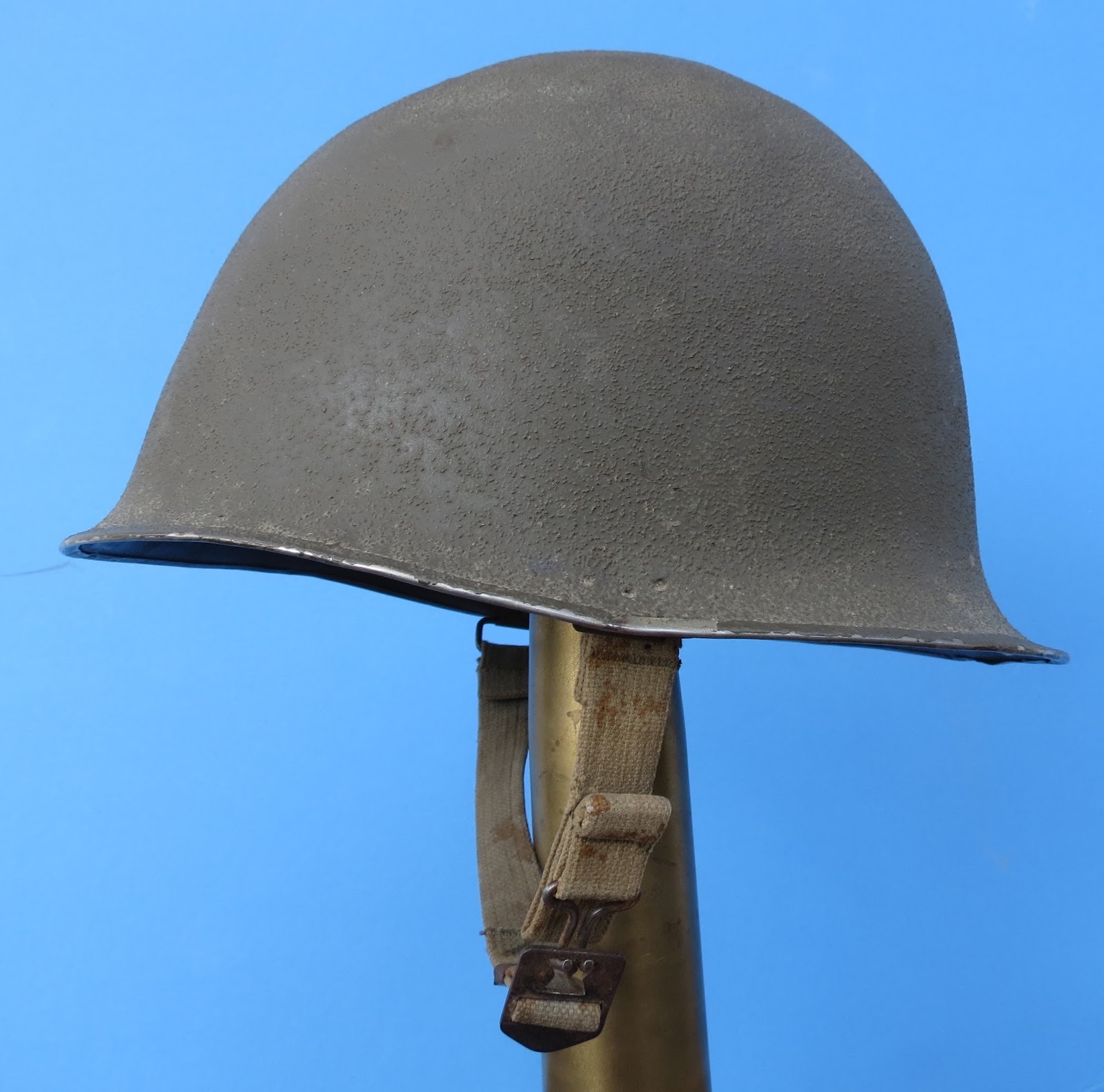
An American icon (a repost of a classic helmet)
(disclaimer: There's a lot more that I don't know about M1 helmets, than I do know about M1 helmets.)
The US M1 helmet replaced the M1917A1 helmet that the United States was using at the very opening of the Second World War. The M1917A1 Had the same "wash-basin" profile of the WWI doughboy helmet, though with an improved liner.
These GIs are wearing the M1917A1 helmet, and from the mix of Springfield and Garand rifles, the photo was taken between 1936 and the opening months of 1942.
I did a post on the M1917A1 that you can link to here,
The War Department started looking for a replacement soon after the First World War, and it took many years, and many experimental versions, to eventually develop the M1. Here's a short video I made about one of the experimental helmets that was tested as a possible replacement for the M1917A1:
Here's the walk around or this American military icon:
Note the textured surface. This was achieved by mixing ground cork into the paint, it provids a nice non-reflective finish. Also observe the join in the rim. Often referred to the seam. All M1s have this joinery either in the front of the helmet or the rear. If you have a "front-seam" helmet, you can be assured that it is from WWII. The seam moved to the rear of the shell sometime in late 1944 (Armold, 92), and that is where it remained until production ceased decades later. Accordingly, just because you have a rear-seam doesn't automatically identify it as a post-war helmet...so you can relax a little about other collectors pooh-poohing the pedigree of your helmet in a merely reflexive way.

The flexible chinstrap loop, or bail, was introduced in November of 1943 (Giard, Blais, 8), prior to that the loops were fixed, and because they extended beyond the rim of the helmet they frequently broke when dropped or sat upon. It is worth noting that Chris Armold in his book Steel Pots, asserts that this change was made in October of '43 (Armold, 94).
In the center of the frame you can see the top-half of the upper-case "S" that is the. manufactures mark for the Schleuter company. The vast majority of M1 shells were manufactured by McCords, in 1943,to supplement the numbers, Schleuter was contracted to produce additional shells (Giard, Blais, 7).


This is the so-called "heat of the steel" marking. I don't really know what these indicate. Most believe that they can be used to determine the approximate month and year of manufacture of the shell - as a matter of fact there are published charts made by individuals purporting to provide this information. It is noteworthy that there is often conflicting information on these charts. Some collectors believe that these numbers provide only the most general dating information, while others assert that these numbers have nothing whatsoever to do with dating the shells. I make no claims, refutations, or arguments one way or the other, I'll leave that to those who know a lot more than I do. Even the esteemed Company of Military Historians opines:
"...Beyond this, the stamp had little meaning to collectors or any effect on perceived value until the fall of 2007.
The tipping of the scale, from mundane to becoming a major consideration in determining the value of a given M-1 helmet, coincides with the publication of a “lot number chart” claiming to pinpoint the pressing of a McCord helmet body to within the specific month of the year it was fabricated.2 Although the chart, in its description of use, claims only to approximate a date, and the book in which it was published provides no bibliographical support or explanation for how the author arrived at the charted timelines, a large section of the collecting community has adopted its findings as gospel.
Historians have always put forth hypotheses regarding the specifics of history, however doing so without providing the source for ones published conclusions creates conjecture and misunderstanding.
Perhaps one day actual pressing records will surface, but until such time each M-1 helmet collector/historian must answer for himself how to handle lot and lift numbers – as a divining rod or as a tool. " (1)
As long as we are on the subject of veracity, I have a pretty healthy bookshelf of helmet books. I find it a little disconcerting that out of all of these books only one cites sources and only a few provide a bibliography. Although some have reproductions of original documents, for the most part, the reader is left to simply take the author's word for it regarding all of the information in the book. What I find worrisome, is that without primary sources, citations, and bibliographies, this hobby may be resting on a foundation of conjecture and folklore rather than documented fact.
A disclaimer to the foregoing - There are many collector/authors who, in their published works follow the tenets of good historiography, and back up their assertions with cited sources; and you may have some of those works on your bookshelf.
This is an issue that I've only recently been thinking about, and I think that it's important enough to mention here. Regular readers of this blog may note that beginning with this post, I am citing sources and providing a bibliography. I want to practice what I preach, and hopefully, be a better resource for beginning collectors - those whom I consider my primary audience.
So please forgive my past lapses.
Now, a look at the chinstrap.
Like the "heat of the steel" numbers, the original hook-and-arrow. closure chinstrap has also generated a wealth of conjecture. One repeatedly hears that the reason that WWII GIs didn't usually fasten their chinstrap, was that they believed that any nearby explosion would cause their helmet to jerk back, thus breaking their neck and killing them. Here is what the US Army Medical Department has to say on the subject:
"During the course of the North African campaigns in 1943, the rigid hook fastener of the chinstrap was found to be a source of potential danger by remaining intact under the impact of a blast wave resulting from a nearby detonation and thereby jerking the head sharply and violently with the production of fractures or dislocations of the cervical vertebras. Therefore, it was necessary to redesign the helmet strap with a ball-and-clevis release so that it would remain closed during normal combat activities but would allow for a quick voluntary release or automatic release at pressures considerably below the accepted level of danger. Following extensive tests by ordnance engineers, a new release device was developed which would release at a pull of 15 pounds or more. This device (fig. 308) was standardized in 1944." (2)
 |
|


That the two components could be separated was a masterful piece of design; it allowed the soldier to still have lightweight headgear of military appearance, and it freed-up the steel helmet shell to serve a myriad of other purposes, including...
as a shovel for excavating foxholes...
a pot for cooking rations...
a shaving sink...
a foot bath...
a wash-up before lunch.
The liner was also used as a stand-alone piece of lightweight and military headgear, which was particularly nice in hot weather, especially in rear areas.
Here's an Army captain using his liner as a military hat, note the painted captain's insignia.
Even celebrities got in on the act -
Here's one other than Elvis Presley photographed in his Army days; staying a cool cat in his lightweight liner.
This broken Westinghouse liner provides a good opportunity to view its construction; what Chris Armold identifies as duckcloth and resin (Armold 108).
Note the stud for the leather chinstrap.
The grommet in the front of the liner may have been for mounting insignia, a widely-held belief, which I've no reason to doubt. (If any reader has a photo of an insignia being deployed in this grommet, kindly send it to me so I can update this entry.)
"A" washers" are another component that soldiered-throughout the variants of the suspension over the years.
Hallmark of the Riddell liner system are these web tapes in the crown of the liner that form the suspension.
A sliding-buckle at the rear of the headband provides adjustment for a snug fit.
Many of the liner components have manufacturers marks. Here, the headband was made by Gem-Dandy Inc. They are still in business (https://www.gem-dandy.com) and manufacture belts and such, yet another example of switching from civilian to war-time production, and then back again.
the nape band, neck band, or neck strap (I've seen all of the three terms used) was made by E.M.C. Finding and researching markings like these is much of the fun of collecting.
These clips affix the headband to the suspension and appeared throughout the lifetime of all M1 liner variations, and they are also present in nearly every M1 clone used by other countries. It is generally accepted that these clips, whether in green or black, can help determine the phase of the war in which the liner was produced, some asserting that the change from black to green began in 1943 (Reynosa, 51).
The "W" in the inside dome, indicates that the liner was manufactured by Westinghouse. This is a far-cry from home appliances, and is a reminder that nearly the entire manufacturing base of America was. switched over to war time production.
The "H" stands for Hagerstown MD, which is just ten miles down the road from me. I sometimes have a fantasy that I'll go to the antique mall and find a whole box of these that some former worker had in her attic. Wouldn't that be swell? I don't know where in town this manufacturing facility was located, nonetheless, it was a nice surprise to find this local connection.
Two garter fasteners affix the leather chinstrap to the liner. Sometime in the 1950s, this strap, and corresponding mounting studs, disappeared.
Here's an interesting note (interesting to me, at any rate): later in the war, that little dimple in the stud disappeared, which can help you identify the rough production-era of the helmet. Details like that are a tricky thing that many collectors get hung on, and they try to specifically date a helmet/liner by its constituent components. That's kind of a trap, as all of those individual components were used until the supply was exhausted. For example, I was in the US Navy from 1970-'74. Although it was the Vietnam-era, most of the helmets/liners onboard were WWII production...we even had a couple of Hawley liners kicking around. Similarly, one hears collectors decrying that a front-seam helmet has a late-war liner...well sure, liners wear out, the suspension breaks or rots, rivets come loose, so a GI finds a better liner and slips it in the shell, or the helmet gets reconditioned at a rear-echelon depot...is it still a legitimate WWII helmet?...absolutely. Don't worry too much about that stuff.

When I got the helmet the strap was broken, as they often are. I repaired it using archival adhesive and a small piece of acid-free Bristol board paper. I've used this technique before, it works very well, it doesn't show, and it is reversible.
As soldier cartoonist, Bill Mauldin reminds us...
the venerable M1 helmet was not bulletproof.
Following WWII, millions of surplus M1s were given or sold to foreign countries who allied themselves with the West. Eventually, many countries developed their own "clone" M1 helmets, nearly identical to that of the United States M1. Eventually, I hope to be doing a post, and perhaps a video, covering the "Euroclone" helmets.
Below is just a sampling of the many countries that adopted the M1-style helmet:
Belgium, Japan
Australia
Mexico, West Germany, Brazil
Cambodia, Canada
Chile, South Vietnam
France, Argentina
Taiwan, South Korea, Nigeria
This was the helmet of my father's generation, and of my generation. Through victory and defeat it represented the American GI for decades.
Best wishes from someone who used to wear one of these (in haze gray).
I'll see you next time with another cool helmet from the collection.
Mannie
Sources:
(1) M-1 Helmet lot numbers, Marc W. Giles, Journal of the Company of Military Historians, fall 2018.
(2) Wound Ballistics in World War II, ed. Col. James Boyd Coates jr. Medical Department, United States Army, p.646, 1962
Armold, Chris. Steel Pots: The History of America's Steel Combat Helmet. 1997.
Blais, Frederoc, Giard, Regis. Helmets of the ETO. History & Collections, 2007.
Reynosa, Mark A. The M-1 Helmet: A History of the U.S. M-1 Helmet in World War II. Schiffer, 1996.