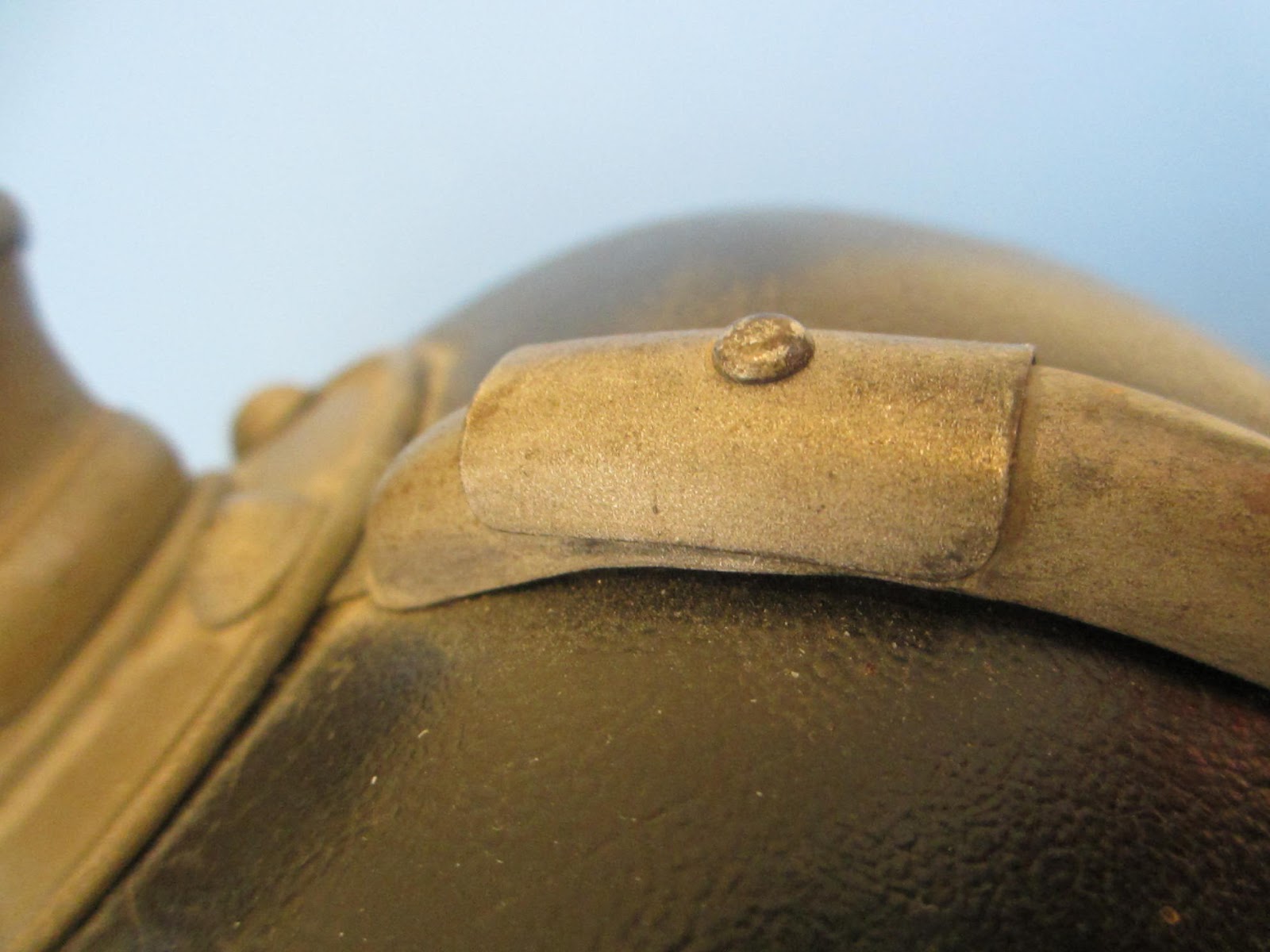
Well now, after all of those tanker lids, isn't this a refreshing treat?
Here's a very nice way to segue out of tanker helmets and back into the rest of the combat helmet world; a very showy 3rd Armored Division "parade liner".
I'm guessing that this is from the 1950s, the Elvis era, early Cold War, that is.
 Lieutenant Kelley, If you're out there:
a. welcome to the future
b. what can you tell us about yourself and your helmet liner?
 Nice Third Armored Division decal. Note the faux chinstraps achieved with, as near as I can tell, masking tape. This is the second such M1 liner in white livery that I've seen with tape representations of straps. I guess if everyone is doing it at the same time for the same event it can look pretty cool. And back when I was a G.I. a very high premium was placed upon looking "cool", that is to say; non-regulation in a very calculated (and often expensive) manner.
 Little is left of the decal on the other side.
 Top veiw demonstrates that this liner has been knocking around for some years. Bet its been used to play "army" in the backyard more than once. While still actively soldiering these tricked-out parade helmets are very, very perfect in all of their snow white glory. This one's been around the block a few times since it went back to civilian life. Now there's a familiar story.
 The back is unremarkable save for the "bubbling" of the tape.
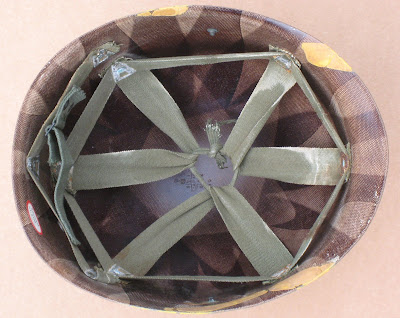 The webbing is that darker green shade of the Korean war era. Note the studs for the leather chinstrap, also the front insignia grommet appears in the very first view.
 Nice Third Armored Division decal. Note the faux chinstraps achieved with, as near as I can tell, masking tape. This is the second such M1 liner in white livery that I've seen with tape representations of straps. I guess if everyone is doing it at the same time for the same event it can look pretty cool. And back when I was a G.I. a very high premium was placed upon looking "cool", that is to say; non-regulation in a very calculated (and often expensive) manner.
 Little is left of the decal on the other side.
 Top veiw demonstrates that this liner has been knocking around for some years. Bet its been used to play "army" in the backyard more than once. While still actively soldiering these tricked-out parade helmets are very, very perfect in all of their snow white glory. This one's been around the block a few times since it went back to civilian life. Now there's a familiar story.
 The back is unremarkable save for the "bubbling" of the tape.
 The webbing is that darker green shade of the Korean war era. Note the studs for the leather chinstrap, also the front insignia grommet appears in the very first view.
 And there's the familiar CAPAC cross. Chris Armold notes in his "Steel Pots" that CAPAC dated their liners in the crown, leaving me wondering if that's the "53" the "51", or the "52"
 "Spearhead" The Third Armored Division has a remarkable history which you can begin to explore by going here.
The Division also set the standard for "cool" in the U.S. armed forces by its choice of personnel:

And here's a Youtube of Elvis as a G.I.
Rock on!
See you next time with another cool helmet from the collection.
Mannie